Calm and quiet · Garden design ideas
Japanese garden design
Quiet structure, borrowed scenery, deliberate emptiness.
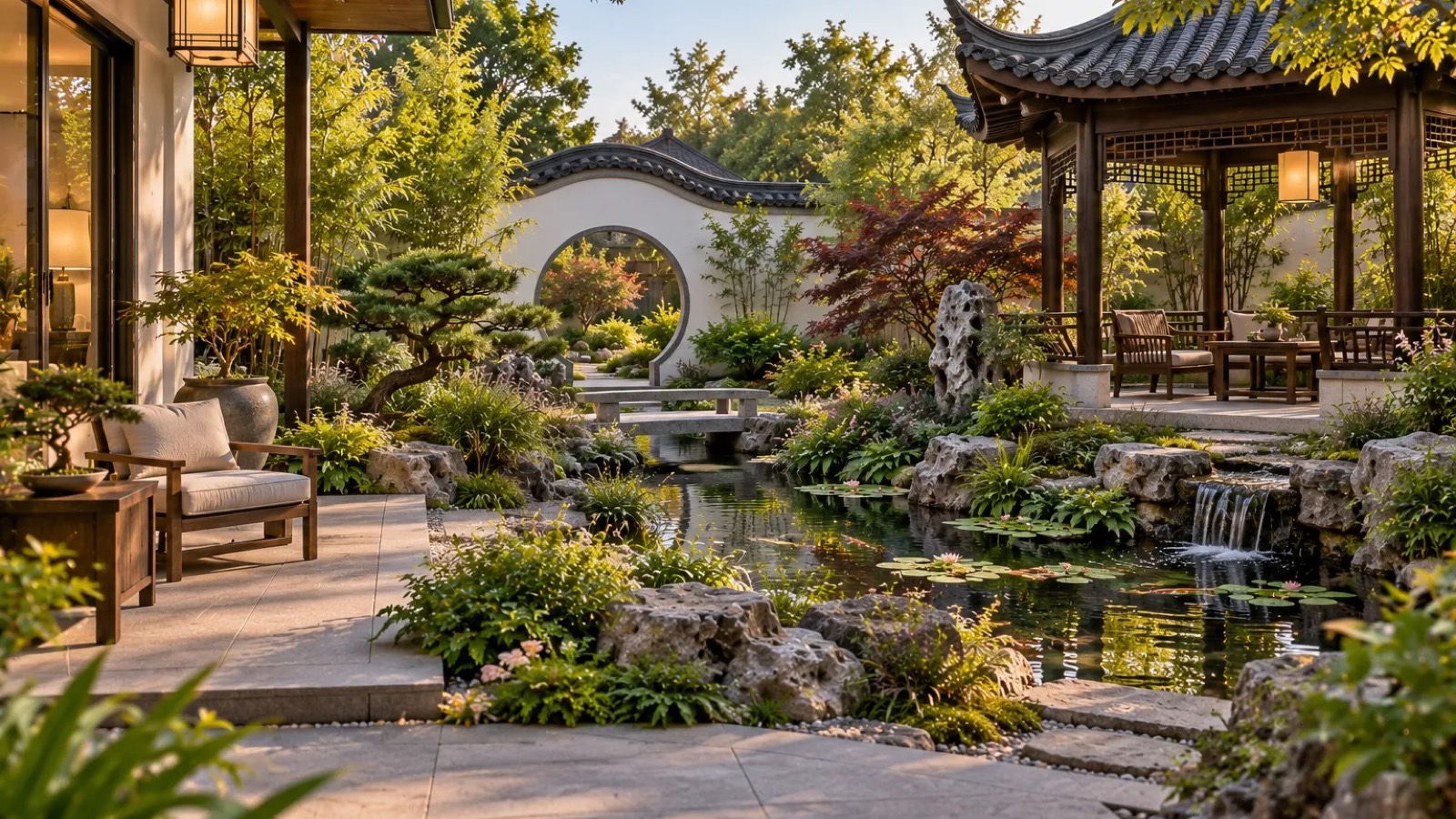
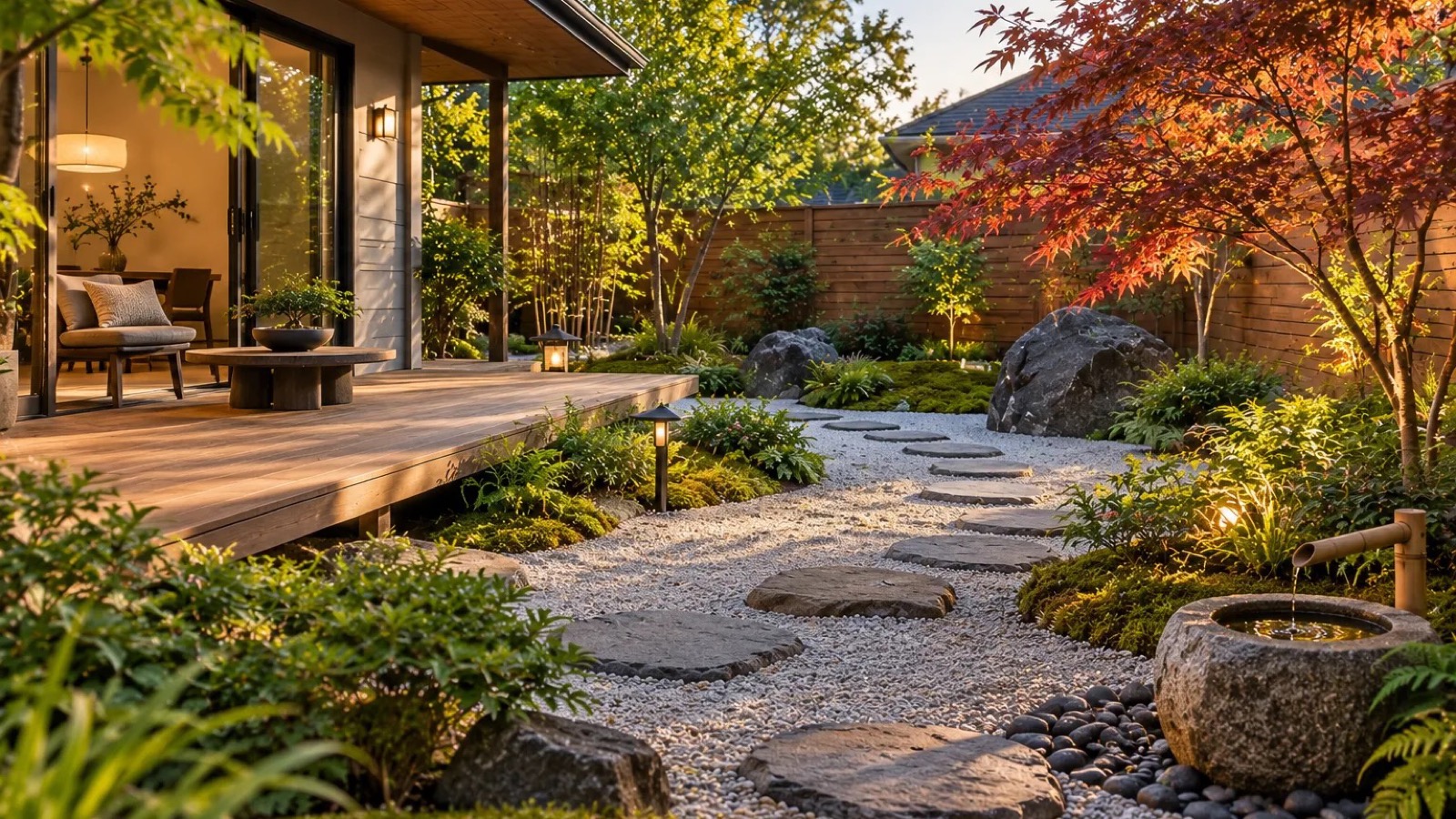
A Japanese-influenced garden uses a small number of strong elements — a wooden deck or engawa-like platform, a gravel or stone area, carefully placed rocks and a single maple or pine — with intentional empty space between them. The composition is asymmetric on purpose: one element leads, the others support it, and the gaps are as designed as the objects. Enclosure matters more than size — a fence, hedge or wall frames the view so the garden reads as a complete world rather than a corner of a larger yard. Because the garden is usually read from the house, the deck edge, a window or a door becomes the frame: design the view from where you actually sit. Restraint carries through materials and planting — one accent color, one seasonal moment, and a palette that stays green through the year.
What defines this style
- Asymmetry and negative space instead of symmetrical beds
- Wood decking at low height, as a viewing platform
- Gravel or raked sand as a design element, not filler
- One specimen tree (Japanese maple, pine) rather than many
- Screening fences to frame views (borrowed scenery)
- A single focal rock or a small stone grouping, never a scatter
- A path that deliberately slows the walk — stepping stones or raked gravel
- Enclosure from a fence, hedge or wall that frames the view
- One seasonal accent (maple red, pine green) rather than a mixed border
- A low, even deck edge that sits close to grade and reads as ground, not furniture
Components that fit
Low wooden deck as the main viewing platform
Simple, unadorned timber privacy fence — screening without fuss
Quiet shrub mass under the tree — moss, ferns and ground cover, green on green
Where grass appears it stays a quiet, level ground plane between stone and moss
Stepping stones spaced for a slow walk, moss invited into the joints
Bare stone paving, understated and even — the surface a tea house would sit on
End-to-end today: dimensions, material estimate and the build guide.
- Gravel area with stone grouping
- Rectangular water basin or small water feature
Planting direction
- Plant — Moss, ferns, and shade-tolerant ground covers under the tree.
- Keep it — Palette green-dominant — one seasonal accent (maple red).
Estimate the main components
Each calculator uses the same formulas as the buildable components on this page — materials with US retail ranges, not a quote.
Common questions
Can a Japanese garden work in a small US backyard?
Yes — the style is often better in small spaces because it depends on composition, not scale. A 12×12 ft area can hold a deck platform, a gravel panel and a specimen tree.
What deck material suits a Japanese garden?
Wood tones read more authentically than bright composites; a low platform deck in a warm brown composite can still fit if the color is muted. Height matters more than material — keep it close to grade.
How much maintenance does a Japanese garden need?
More than a low-maintenance yard if you rake gravel or keep moss, less if you choose grasses. Decide up front whether the raked pattern is part of your routine or a one-time detail.
Do I need a pond or water feature?
No. Water is one option, not a requirement — a dry stream of gravel, a stone basin or a simple bird bath carries the same idea with far less upkeep. If you do add water, budget for cleaning, topping up and winter protection; a still basin is easier to keep than a pump-fed stream.
What should I plant under a Japanese maple?
Shade-tolerant ground cover does the work: moss where the soil stays damp, ferns and liriope where it dries out, and low grasses at the edges. Keep one dominant texture rather than a mixed border. If moss fails in your climate, gravel or a low ground cover keeps the composition without fighting the site.
How do I keep gravel from looking like loose fill?
Give it an edge — steel, stone or a buried paver — and keep the depth consistent. Rake patterns read as intentional only when the gravel is contained and free of leaves; a 3–4 inch layer over landscape fabric keeps weeds down without turning the panel into a maintenance trap.
Can a Japanese garden include a lawn?
Yes, as a quiet plane rather than the main event — a level patch between stone and planting, kept simple. The style fails when the lawn becomes the largest surface; keep it secondary and let the deck, gravel and specimen tree carry the composition.
Make it buildable
Upload a photo of your yard — it becomes a real plan: render, components with dimensions, materials and construction steps.
Start freeOr walk through a real yard first — photo in, plan out →Other styles