Grand and ceremonial · Garden design ideas
Classical European garden design
Symmetry, clipped hedges, stone underfoot.
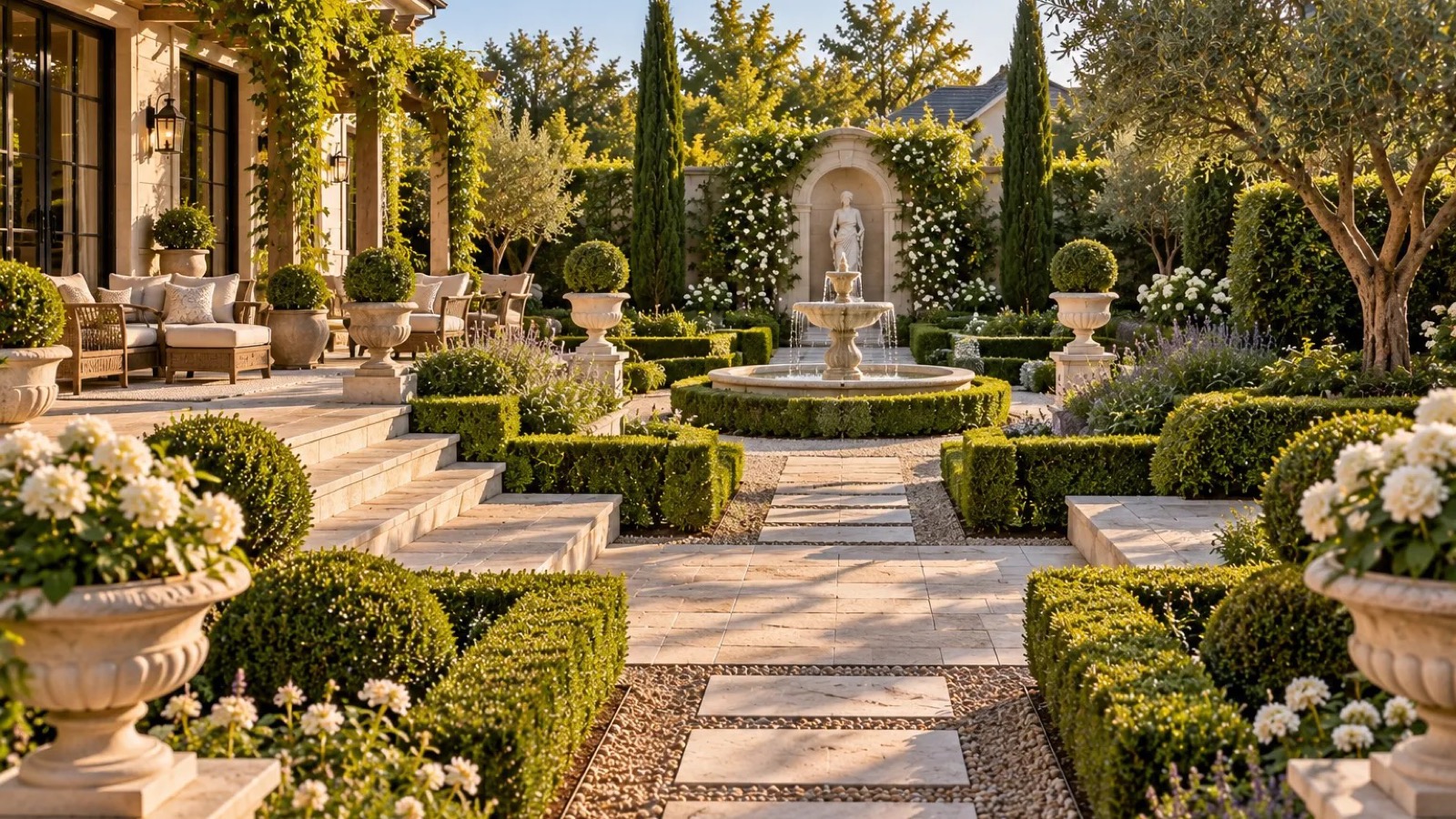
The classical European garden is architecture made of plants: a central axis, symmetrical beds of clipped hedging, stone balustrades and urns, and a fountain or statue as the vanishing point. A scaled-down version — one axis, two symmetrical beds, one strong focal point — fits a suburban lot.
What defines this style
- An axial layout with a strong focal point (fountain, urn, statue)
- Clipped boxwood or holly in geometric parterres
- Stone or limestone-look hardscape — terraces, balustrades, edging
- Formal planting: standards, allées, and disciplined repetition
- Seasonal color added in urns and window boxes, not in the beds
Components that fit
Elevated deck as the terrace — railing at the edge
Formal privacy fence with a crisp top line and consistent picket spacing
Formal clipped hedge — boxwood or yew in symmetric rows, roses in containers between
A formal lawn — level, closely mowed, framed by crisp bed edges and hedges
A straight axis of cut-stone pads leading the eye — paths as the garden's geometry
Cut-stone paving laid in a formal grid, centered on the door like a ballroom floor
End-to-end today: dimensions, material estimate and the build guide.
- Pair of large urn planters flanking the main axis
- Central fountain or water feature as the focal point
Planting direction
- Plant — Boxwood (check for blight-resistant varieties), yew or holly for structure; standard roses and seasonal annuals in containers.
- Keep it — Expect annual clipping to hold the geometry.
Toxic if chewed (ASPCA): Boxwood, Holly, Yew. ASPCA lists Roses as non-toxic. Verify any other plant on the ASPCA list.
Common questions
How much space does a formal European garden need?
The full parterre-and-fountain scheme wants a large lot, but the essence — one axis, two mirrored beds, one focal point — works from about a 30 ft run. Symmetry reads even in small spaces if the materials are honest.
Is boxwood blight a real risk?
Yes — boxwood blight has spread across much of the US, so specify blight-resistant varieties (such as NewGen types) or substitute Japanese holly or yew. Keeping foliage dry and tools clean limits spread.
How much maintenance does the formal look demand?
The pruning is the cost: clipped hedging typically needs two to four trims a year to stay crisp. If that is not your routine, reduce the amount of clipped structure and use containers to carry the formality instead.
Make it buildable
Upload a photo of your yard — it becomes a real plan: render, components with dimensions, materials and construction steps.
Start designingOther styles